
Container Gardens
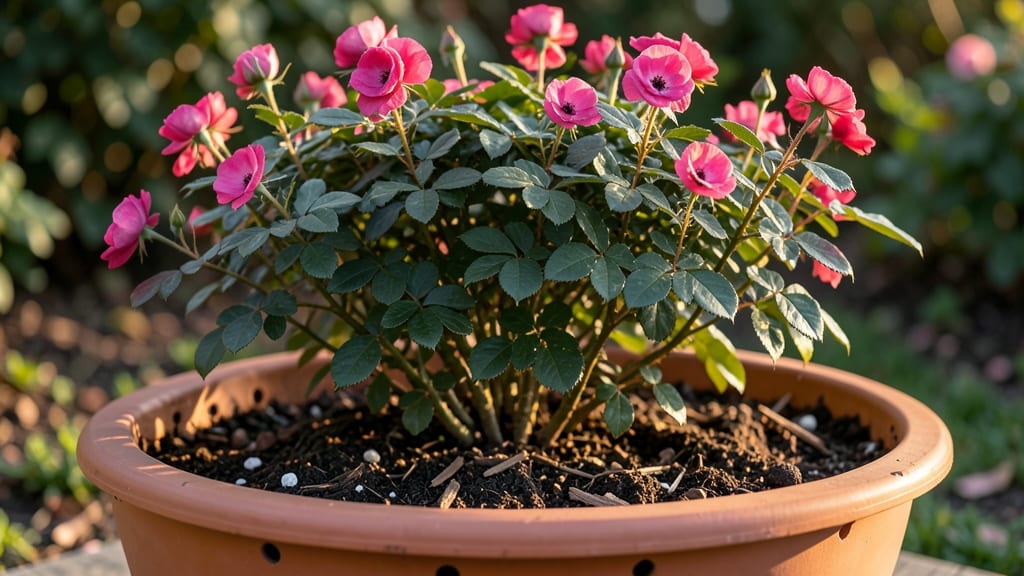
Knockout roses can grow in pots with the right setup: use containers at least 18 inches deep and wide, ensure excellent drainage, and plant in well-draining soil mix to support their vigorous roots while preventing waterlogged conditions.
These roses thrive in containers because they're bred for disease resistance and adaptability, but their root systems need room to expand. Fabric grow bags work well for larger varieties since they allow roots to breathe better than rigid pots. 🌿 I've found that adding a 3-inch layer of gravel or broken pottery at the bottom prevents drainage issues while keeping roots aerated.
The key is balancing moisture—water thoroughly when the top inch of soil feels dry, but never let them sit in soggy soil.
For soil, mix equal parts potting mix and perlite or coarse sand to improve drainage while retaining moisture. A slow-release fertilizer pellet in spring gives them a steady nutrient boost without overfeeding.
Container-grown Knockout roses may need 10-20% more frequent watering than in-ground plants, especially in hot weather, since pots dry out faster.
💡 In This Article
- Why Container Size Matters for Knockout Roses
- Best Pots and Soil Mix for Potted Knockout Roses
Why container size matters for Knockout roses
Knockout roses develop a robust root system that spreads both deep and wide—typically reaching 12-18 inches in depth and 24+ inches in width when mature. This explains why pots smaller than 18 inches in diameter stunt their growth: the roots quickly become root-bound, competing for nutrients and space.
In nature, roses spread their roots laterally to access moisture and minerals, but in containers, this expansion is restricted unless the pot provides adequate volume. 🌱
The science behind this lies in the plant's hydraulic lift system—roots absorb water from deeper soil layers, but when confined, they can't access enough moisture, leading to wilting even when the surface soil appears damp.
Larger pots also allow for better temperature regulation: smaller containers heat up faster in sunlight, stressing the roots. I've observed that fabric grow bags (which are 20-25% larger than their labeled size) often outperform rigid pots because they accommodate root spread without binding.
Drainage holes play a critical role here—without them, excess water pools at the bottom, suffocating roots through lack of oxygen. The ideal setup includes a 3-inch drainage layer of gravel or broken pottery at the container's base, followed by a well-draining soil mix.
This prevents waterlogging while allowing roots to breathe. For varieties like 'Double Knock Out' roses, which grow 3-4 feet tall, a 24-inch pot is often necessary to support their height without toppling.
Seasonal factors also influence container size needs. In summer, pots dry out 30-50% faster than in-ground soil, so larger containers retain moisture longer. I've found that moving pots to shaded areas during peak heat reduces evaporation stress.
Conversely, winter care requires pots to be slightly smaller to prevent freezing—roots in oversized containers can't insulate themselves as effectively as in-ground plants when temperatures drop below 20°F.
Root stress manifests visually: yellowing leaves, stunted growth, or flowers that drop prematurely often signal a pot that's too small. The solution? Upgrade to a container that's at least 50% larger in volume than the current one.
For example, a 12-inch pot should transition to a 18-inch pot—not just a slightly larger 14-inch version. This gives roots the space they need to recover and thrive.
One common misconception is that deeper pots are always better, but width matters more for roses. Their roots spread horizontally first, then grow downward. A 12-inch deep but 24-inch wide pot will often outperform a 24-inch deep but 12-inch wide pot for these varieties.
This horizontal expansion helps them anchor better and access more soil volume for nutrients.
For those with limited space, consider dwarf Knockout varieties like 'Radrazz Berries'—they thrive in 12-inch pots but still produce abundant blooms. The key takeaway: match your container's dimensions to the rose's mature size, prioritizing width over depth, and always prioritize drainage to prevent root suffocation. 🌿