
Flowers
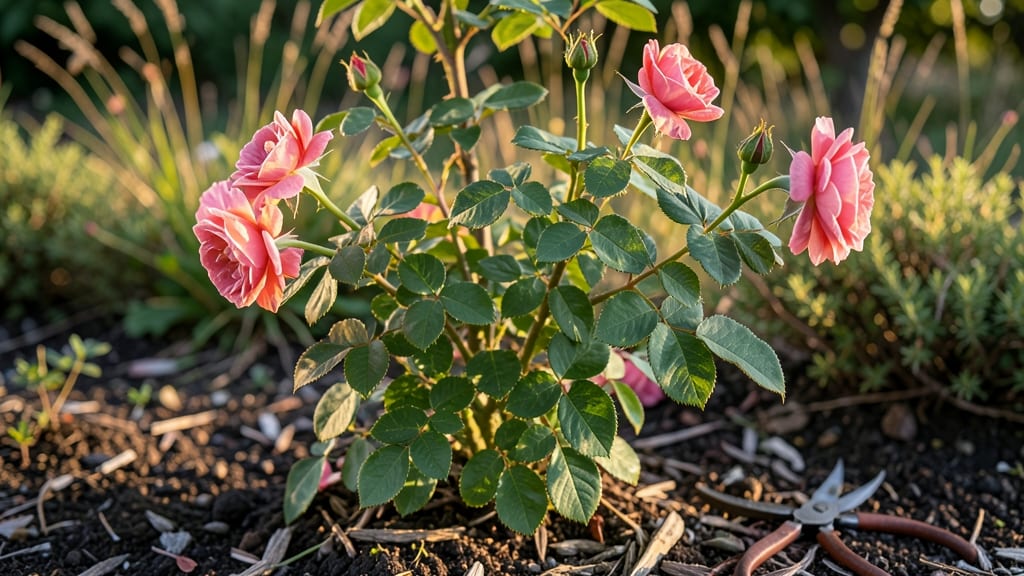
Rose leaves look like elongated, deep green ovals with serrated edges and five to nine leaflets, often with a glossy texture and small thorns along the stems. Each leaflet tapers to a point and features fine, sharp teeth along the margins.
Rose leaves are instantly recognizable by their compound structure—each leaf is made up of multiple smaller leaflets arranged along a central stem. 🌿 The deep green hue and slightly waxy finish help them stand out against other foliage, while the thorns along the stems serve as a natural defense mechanism.
What's fascinating is how the leaflet count varies: hybrid tea roses typically have five to seven leaflets, while climbing roses often display seven to nine. This variation can help gardeners identify specific rose varieties just by looking at the foliage.
When comparing rose leaves to similar plants, pay attention to the arrangement and shape of the leaflets. Unlike raspberry or blackberry leaves, which have three distinct leaflets, rose leaves feature a longer, more intricate structure.
The serrated edges and pointed tips create a unique silhouette that's hard to mistake once you know what to look for.
💡 In This Article
- Identifying Rose Leaf Anatomy and Variations
- How to Distinguish Rose Leaves from Similar Plants
Identifying rose leaf anatomy and variations
The compound structure of rose leaves begins with a central stem called the rachis, which supports 5 to 9 individual leaflets arranged alternately along its length.
Each leaflet typically measures 1 to 3 inches long and 0.5 to 1.5 inches wide, creating an elongated oval shape with a pointed tip. The edges feature fine serrations resembling tiny teeth, a key identifying trait that sets them apart from smoother-leaved plants.
Hybrid tea roses showcase the most common leaf arrangement with 5 to 7 leaflets, while climbing roses often display 7 to 9 leaflets per stem. The vein pattern reveals another distinguishing feature: prominent midribs running through each leaflet, accompanied by secondary veins that create a delicate web-like structure.
These veins contribute to the leaf's glossy, waxy texture, which helps repel water and pests while reflecting light to maximize photosynthesis.
The placement of thorns along the stem provides additional identification clues. Rose thorns typically appear in clusters of 3 to 5 at leaf nodes, with the largest thorns measuring 0.5 to 1 inch long. These sharp, curved spines serve as a natural defense mechanism against herbivores.
Seasonal changes affect leaf appearance too: new growth in spring appears lighter green with softer edges, while mature summer leaves develop a deeper, richer hue and more pronounced serrations.
Understanding these variations helps gardeners distinguish between rose species. For example, English roses often have slightly broader leaflets with more rounded tips compared to the narrower, more pointed leaflets of Floribunda roses.
The leaflet arrangement also differs: some varieties like Climbing roses may have slightly overlapping leaflets, while Shrub roses tend to display more evenly spaced leaflets along the stem.
Another fascinating detail is how leaf size correlates with rose growth habits. Larger leaflets often appear on vigorous, fast-growing varieties, while smaller leaflets typically belong to more compact or dwarf roses.
This relationship between leaf anatomy and plant physiology highlights why rose leaves aren't just decorative—they're functional components that influence the plant's overall health and growth pattern.
When examining rose leaves closely, you'll notice the upper surface tends to be darker green and more glossy than the paler underside. This color differentiation helps regulate temperature and moisture levels within the leaf.
The combination of these anatomical features—the compound structure, serrated edges, vein patterns, thorn placement, and seasonal color changes—creates a distinctive visual signature that makes rose leaves instantly recognizable to trained eyes.