
Pruning
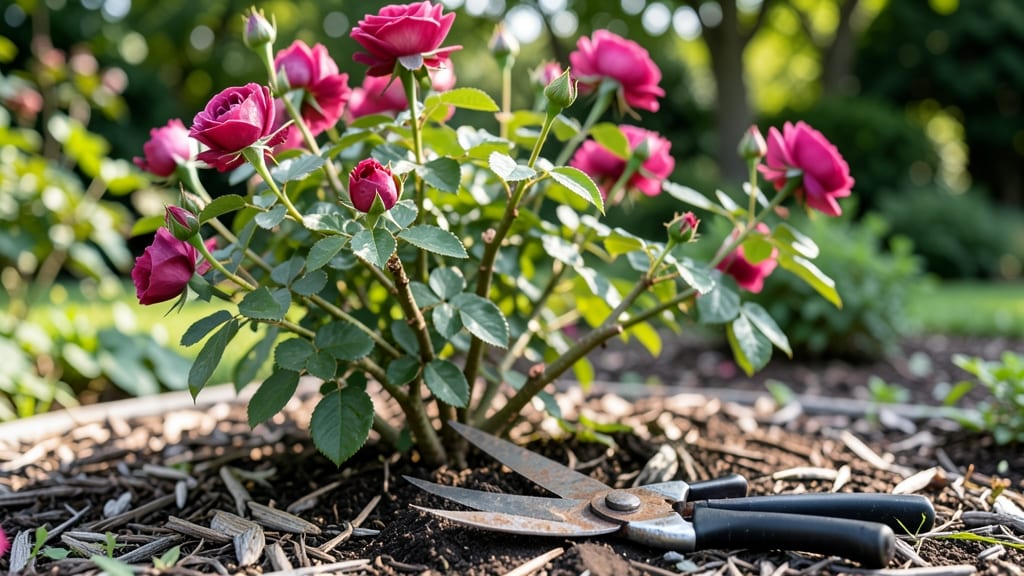
To prune roses the right way, you’ll cut back one-third of last year’s growth—no more, no less. ✂️ I’ve learned the hard way that aggressive pruning leads to leggy canes and fewer blooms, while skimping leaves your roses crowded and vulnerable to disease.
The key is matching your cuts to the rose type and season, whether you’re shaping hybrid teas for dramatic blooms or letting climbers sprawl naturally.
Hybrid teas and floribundas need 20-30% of their canes removed in late winter, while old garden roses and climbers tolerate 10-20%—think of it as sculpting, not hacking. I always start by removing dead or crossing branches first, then step back to visualize the plant’s natural shape.
A sharp pair of pruners and a clean workspace make all the difference, especially when dealing with thorny canes that resist even the most confident hands.
What you’ll end up with is a rose bush that bursts with stronger stems and more abundant blooms by summer. The first flush of flowers arrives faster, and the plant directs energy where you want it—into vibrant petals instead of tangled growth.
Even my black thumb can’t mess this up once I got the timing and technique right.
This method works year-round, with light trims after major blooms to encourage a second flush. Whether you’re a beginner or a seasoned gardener, the secret is patience—pruning is about gradual improvement, not instant perfection. Let’s get those canes looking like showstoppers!
📚 In This Guide
- What you need
- Instructions
- Tips and common mistakes
- Wrapping up and next steps
What you need
- ● Bypass pruners – Sharp, clean, and designed for clean cuts (1 pair). Avoid anvil pruners, as they crush stems.
- ● Loppers – For thicker branches (½"–1½" diameter) (1 pair). Look for bypass-style for precision.
- ● Pruning saw – For stubborn, woody stems (over 1½" thick) (1). A fine-tooth blade prevents tearing.
- ● Disinfectant (70% isopropyl alcohol or bleach solution) – 1:9 bleach-to-water ratio (small spray bottle or cloth). Prevents disease spread.
- ● Garden gloves – Heavy-duty, cut-resistant (1 pair). Protects hands from thorns and debris.
- ● Rake or broom – For clearing pruned debris (1). Helps keep the garden tidy.
- ○ Marking twine or tags – Optional but helpful for labeling pruned sections (small roll). Useful for tracking growth.
- ● Pruning sealant – For large cuts (over ½") (small bottle). Speeds healing but skip for small cuts.
- ● Hand pruners with a magnifier – For detailed work on small roses (1 pair). Great for precision.
- ● Knee pad or stool – For comfort during long sessions (1). Saves your back!
- ● Compost bin or bag – For collecting pruned material (1). Repurpose clippings as mulch.
Step-by-step guide to pruning roses for peak bloom performance
Here’s my go-to approach for pruning roses—whether you’re a beginner or just need a refresher. The key is timing, technique, and knowing how much to cut back.
✂️ Step 1: Prune in Late Winter or Early Spring for New Growth
Start pruning when your roses are still dormant but the ground has thawed—typically 4-6 weeks before your last frost date. This timing ensures new growth kicks in as soon as the weather warms. Look for bare branches with no leaves or buds; these are ready for pruning.
Remove dead, diseased, or crossing branches first. Cut these back to the ground or to a healthy outward-facing bud, depending on the severity. I always make cuts at a 45-degree angle, about ¼ inch above an outward-facing bud—this encourages the branch to grow outward rather than inward.
✂️ Step 2: Thin Out Crowded Canes for Better Airflow
Next, focus on thinning the center of the rose bush. Aim to remove about ⅓ of the oldest, thickest canes—these are the ones that produce fewer blooms and compete with younger growth. You’ll know you’re doing it right when you can see light penetrating the center of the bush.
For hybrid teas and grandifloras, cut back last year’s blooming stems to 4-5 buds from the base. This ensures strong, healthy canes for the next flush of flowers. If a cane is weak or spindly, prune it back harder to stimulate new, robust growth.
✂️ Step 3: Shape the Bush for Balance and Structure
Step back and assess the overall shape of your rose bush. You want a rounded, open center with branches spaced evenly apart. Cut back any branches that are growing inward or rubbing against others—these will weaken the plant and invite disease.
For climbing roses, prune side shoots back to 2-3 buds and remove any that are growing parallel to the main stem. This keeps the plant strong and encourages upward growth. Always leave at least 3-5 strong canes on climbing roses to support future blooms.
🌿 Step 4: Light Summer Pruning to Encourage Continuous Blooms
After the initial spring prune, give your roses a light trim every 6-8 weeks during the growing season. This keeps them bushy and encourages more blooms. Remove spent flowers by cutting just above a set of 5 healthy leaves—this redirects energy to new growth rather than seed production.
Watch for suckers (shoots growing from the base or underground) and remove them immediately. These drain energy from the main plant. A quick glance at the base of your rose bush will reveal any new growth that needs trimming.
⏰ Step 5: Fall Cleanup to Prepare for Winter
In late fall, after the first hard frost, prune again to remove any dead or diseased wood. Cut back all canes to about 12-18 inches tall, depending on your climate. This protects the plant from winter winds and reduces the risk of disease overwintering.
Rake up and dispose of all fallen leaves and debris—this prevents pests and diseases from hiding in the garden. A quick cleanup now means fewer problems next spring. Mulch the base of the plant with 2-3 inches of organic mulch to insulate the roots.
Tips & tricks for perfect rose pruning
Confession: I used to over-prune my roses, thinking more cuts meant more blooms. Turns out, it was the opposite—here's what actually works.
Timing is Everything: That 4-6 week window before last frost is critical. If you prune too early, you risk damaging new buds as they emerge. If you wait too late, you cut off potential blooms. Check your local frost dates and mark your calendar—this is non-negotiable for healthy growth.
The 45-Degree Angle Secret: When making cuts in Step 1, that quarter-inch above the outward-facing bud isn't arbitrary. It creates a natural water runoff path that prevents rot. I've seen beginners cut too close or too far—both lead to weak growth. Practice on a few branches first if you're new to this technique.
Bud Count Matters: For hybrid teas, those 4-5 buds from the base aren't just a suggestion—they're the sweet spot. Too few buds means weak stems, too many means crowded blooms. Count them carefully! For climbing roses, never go below 3 strong canes—this is your structural foundation for next year's growth.
Summer Maintenance Hack: Those 6-8 week summer trims are your secret weapon for continuous blooms. Here's my trick: always remove spent flowers right after they fade. The energy that would go to seed production instead fuels new blooms. I set a reminder every 2 months so I don't forget this crucial step.
Pro Tips for How Much To Prune Roses
- Confession: I used to over-prune my roses, thinking more cuts meant more blooms.
- Timing is Everything: That 4-6 week window before last frost is critical.
- The 45-Degree Angle Secret: When making cuts in Step 1, that quarter-inch above the outward-facing bud isn't arbitrary.
Frequently asked questions
When is the best time to prune roses for maximum blooms?
The ideal time to prune roses is late winter or early spring (just before new growth starts) for hybrid teas and floribundas. Repeat-light pruning can happen after major blooms in summer. Avoid heavy pruning in fall—it stimulates tender growth that may not survive winter. For climbers and shrub roses, prune after flowering.
How do I know if I’m over-pruning my roses?
Over-pruning shows up as stunted growth, fewer blooms, or exposed bare canes. If you’ve cut back more than 1/3 of the plant’s height or removed too many canes (leaving only 3-5 strong stems), your roses may struggle. Look for green buds—if you see none, you’ve likely pruned too aggressively. Step back and assess!
Can I prune roses in cold weather or rain?
Prune roses on a dry, mild day (above 40°F/4°C). Cold weather stresses plants, while rain can spread disease. If you must prune in wet conditions, sanitize tools with rubbing alcohol first and avoid pruning during active storms. Early morning or late afternoon is best—just not when frost is forecasted!
What if I missed the spring pruning window—can I still prune?
Yes! If you missed late winter/early spring, lightly prune in early summer (after the first flush of blooms) to shape the plant and remove dead wood. Avoid heavy cuts—focus on dead, diseased, or crossing branches. Roses are resilient, but late pruning may delay blooming. Better late than never!
Do I need special tools to prune roses, or will regular pruners work?
While sharp bypass pruners work for small stems, roses often need loppers or a pruning saw for thicker canes (over ½ inch). Sanitize tools with rubbing alcohol between cuts to prevent disease spread. A glove (thorn-proof!) and a bucket for clippings are also handy—no fancy tools required!
Wrapping up and next steps
Pruning roses might seem daunting, but with the right timing, tools, and technique, you’ll unlock vibrant blooms and stronger plants! Remember: spring and fall are your best friends for seasonal trims, while deadheading keeps roses thriving year-round.
Start small—confidence grows with practice, and soon you’ll be shaping your roses like a pro. 🌹✂️
Ready to take the next step? Grab your pruners, pick a sunny day, and give your roses the care they deserve. Happy pruning—and enjoy those stunning flowers!